Why PCB Data Management Is an Engineering Problem

There is a folder somewhere on a shared drive named something like "PCB_FINAL_v3_revised_USE_THIS_ONE." If you have spent more than two years in electronics design, you have either created that folder or inherited it. You already know what happens next.

A layout engineer pulls files from it. The schematic was superseded four days earlier when a last-minute component change came through. The Gerber file package goes to the fabricator. The boards come back. The bring-up engineer spends three days assuming it is a layout problem before someone checks the netlist date stamp. Nobody was negligent. The data was wrong, and the process had no way to catch it.

This is not a process story. It is an engineering problem with an engineering root cause, and it has a measurable cost.

What PCB Design Respins Actually Cost

The 2025 PCD&F/Circuits Assembly PCB Designer Salary Survey found that nearly 60% of designers produce one to five respins annually, with respin rates holding stable despite rising board complexity. For engineers working on complex multilayer boards, even a single respin carries costs that compound quickly: fabrication and assembly of the new revision, engineering time to diagnose the root cause, procurement delays if long lead time components were already ordered against the wrong bill of materials (BOM), and schedule slip that cascades into product launch timelines.

Working from mismatched file revisions between fabrication data and the actual PCB design produces an expensive paperweight instead of a functional board. The engineering time to recover from that outcome, trace the source of the mismatch, and re-release correct manufacturing data routinely exceeds the cost of fabrication itself.

According to Aberdeen Group research , designers spend roughly 24% of their time correcting data integrity issues. That is nearly a quarter of every engineering week absorbed not by design work, but by managing data that should have been governed from the start.

The most damaging characteristic of data-driven respins  is that they are invisible in post-mortems. They get classified as design errors or manufacturing process breakdowns. The structural cause, that design data lived in multiple uncontrolled locations and diverged without anyone noticing, rarely surfaces in a corrective action report. Which means the same failure repeats.

Why File Version Control Is Not Enough

Most engineering teams have reached for a familiar tool: SVN version management  or Git based repositories borrowed from software development practice. These tools solve a real problem. They track file changes, maintain history, and prevent two engineers from overwriting each other's work. For firmware and embedded software, they are the right answer. For electronic design automation (EDA) workflows, they are necessary but not sufficient.

The reason engineers reach for SVN version management is not that it is the right tool for EDA software workflows. It is that it is better than a shared drive, and the absence of a better mental model is the problem in itself.

SVN version management and Git track files. They have no understanding of what is inside those files or how the objects within them relate to each other. Consider a schematic change that adds a net class with tighter impedance requirements to an existing signal group. In a file-based workflow without a governed netlist update process, the layout engineer has no notification that the constraint profile the router is working against no longer reflects the current design intent. The routing passes DRC against the previous constraints. The board goes to fabrication. The signal integrity problem surfaces at bring-up.

A general-purpose version control system saw the schematic change and the layout file as two independent file events with no understanding of the dependency between them. It does not know the layout engineer needs to accept the netlist change before the layout is valid. It does not know that the BOM it is working from reflects a component changed in the schematic three commits ago. When a unit fails in the field without clearly versioned and linked design objects, there is no trail of breadcrumbs, just blame.

Design-aware data management, built specifically for electronic design automation (EDA) workflows, understands the relationships between design objects. The schematic capture environment, PCB layout, constraint database, component library, BOM, and manufacturing outputs are not independent files. They are linked representations of the same design, and a change to any one of them has defined consequences for the others. Managing those consequences is what separates design data management from file version control.

What Industry Standards Actually Require

Regulated industries have already worked through this problem. The standards they produced reflect hard learned lessons about what happens when design data is uncontrolled in systems where failure has real consequences. Understanding what these standards require is useful regardless of whether your current designs fall under them, because they define concretely what a mature process needs to produce.

ISO 26262 and IATF 16949: Automotive

ISO 26262 Part 5 requires that hardware design artifacts demonstrate traceability between safety requirements, the hardware design, design verification results, and the release state of the design. The version of the PCB layout analyzed for signal integrity must trace to the netlist it was routed against, which must trace to the schematic capture revision that generated it. Any break in that chain leaves the safety case incomplete.

IATF 16949, required for Tier 1 and Tier 2 automotive supplier participation, adds documented design records, formal change management traceability, and evidence of design review at defined program gates. These are contractual deliverables that purchasing organizations audit against. Together, ISO 26262 and IATF 16949 define a data management requirement that a shared drive and email workflow cannot satisfy.

AS9100 and DO-254: Aerospace and Defense

AS9100 revision D requires configuration management of design data, documented change control, and traceability of design outputs back to their generating inputs. DO-254 adds hardware-specific requirements that map directly to version control and design review practice. For hardware at Design Assurance Level A or B, every design artifact including schematics, PCB layout data, simulation tools outputs, and verification records must be under configuration control, and the relationship between those artifacts must be demonstrable at audit.

Inadequate configuration management does not just risk audit failure. It risks program disqualification.

Figure: (Need Bibbuti to recreate) DO-254 Design Assurance Levels define hardware development obligations based on the consequence of failure in flight. At Level A and B, where failure outcomes range from catastrophic to hazardous, target failure rates are measured in fractions of a chance per billion flight hours. These are the assurance levels where DO-254 requires enhanced configuration management, meaning every design artifact must be version controlled and traceable, and where a data management process that cannot produce that traceability on demand disqualifies a supplier before a program enters production.

FDA 21 CFR Part 820 and ISO 13485: Medical Devices

21 CFR Part 820 requires manufacturers to maintain a Design History File demonstrating the design was developed in accordance with the approved plan. 21 CFR Part 11 requires electronic records to carry full audit trails. ISO 13485 extends this to the supply chain. A Design History File that cannot be reconstructed delays or blocks a regulatory submission, with consequences measured in months of lost market access.

BOM Management and Supply Chain Risk

The BOM sits at the intersection of engineering design and every downstream business process: procurement, manufacturing resource planning (MRP), enterprise resource planning (ERP), and product lifecycle management (PLM). Effective BOM management requires treating it as a live engineering artifact, not a periodic export.

The BOM originates in the PCB design software environment. By the time a design reaches production, multiple versions of it typically exist simultaneously. Procurement is working from a spreadsheet built from an earlier export. Manufacturing BOMs reflect the build process rather than the current design state. Sustaining engineering is tracking lifecycle risk in a separate database. Each view is derived from the same core BOM, but each has diverged.

The result is errors, delays, misbuilds, and double ordering across production processes, with no single source of truth and no mechanism to force reconciliation. By the time the failure surfaces it has traveled through procurement or the manufacturing process and lost its connection to the design decision that caused it.

BOM management software closes this loop by keeping a single governed BOM synchronized across the PCB design software environment, PLM, and ERP, so every stakeholder is working from the same current data rather than a snapshot that has already moved on.

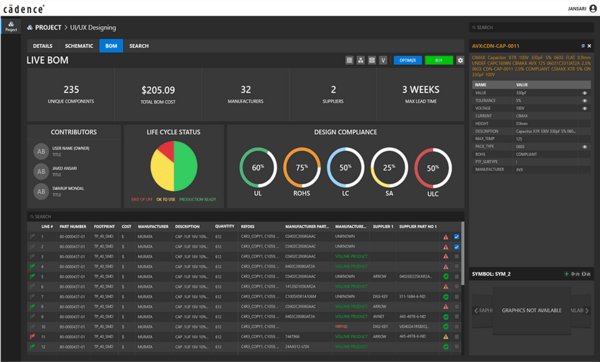
Figure: Allegro X PCB Live BOM gives engineers and supply chain stakeholders a real-time view of component data, total BOM cost, lifecycle status, and design compliance across UL, RoHS, and other regulatory frameworks. As engineers place and modify components in the design, the BOM updates, replacing the static spreadsheet export with attributed, governed data accessible to all stakeholders without a file handoff.

The Library Is Where Data Problems Begin

Component library management is where fragmentation originates and where it is cheapest to stop. Consider the more common failure: a component placed into a new design that moved to Not Recommended for New Design (NRND) status six weeks earlier, undetected because the library had no live connection to supply chain data, discovered at first article inspection when the contract manufacturer (CM) cannot source it. That is a data management failure, not a design failure, and it costs the same as a respin regardless of how it is classified.

In teams without a governed library process, engineers populate material component attributes inconsistently and reuse parts without verifying supply chain status. A component with an outdated lifecycle status, an incorrect land pattern, or a missing simulation model is a defect that propagates into every design that uses it. When a compliance audit reveals that a material component attribute required for RoHS or REACH documentation was never captured, the cost traces back to a library governance gap that existed long before the audit.

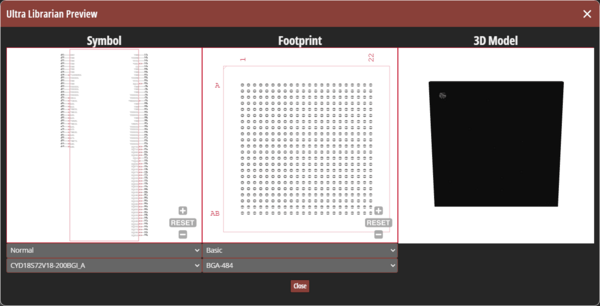
A governed library process gates components through authoring, technical review, and formal release before they reach the design engineer. That sequence is what prevents an unverified supply chain status from entering the design database in the first place, and it is the foundation of design for manufacturability at the component level.

A Self-Assessment Framework

These questions provide a practical baseline for evaluating your current process at a high level, regardless of what EDA software or design software you use.

On version control: Can you identify with certainty which schematic capture version was used to generate the netlist the current PCB layout was routed against?

On BOM management: When approved alternate MPNs are updated in PLM, does that change propagate automatically to the CAD library in real time? Or is there a window where a designer can place a part against an outdated approved list without knowing it?

On library governance: When a component moves to NRND or end of life (EOL), does that change propagate to every design currently using that part? Or does the team find out when the CM flags a sourcing problem during a production run?

On traceability: If a regulatory audit required you to demonstrate that the released manufacturing package was generated from a specific design database state, how long would that take? Minutes, hours, or weeks?

On manufacturing output control: Is there a mechanism that prevents a manufacturing package from being released unless it was generated from a released, version-controlled design revision? Or can a designer zip a Gerber file package and send it to the CM without anyone verifying it matches the current PCB design state?

If any of these questions produce uncertainty rather than a confident answer, the gap has a cost attached to it. A single data-driven respin on a complex multilayer board routinely runs to tens of thousands of dollars before long lead time component delays are factored in. If the answer to any of these questions depends on individual engineer discipline rather than a governed process, the risk is already present. Governed library workflows, versioned netlist processes, and live BOM management all remove the category of failure where the engineering work was correct but the data undermined it and directly improves productivity across the design and manufacturing process.

What Structured Data Management Looks Like in Practice

For teams using the Allegro X PCB Platform, the Allegro X Collaboration Server implements design-aware data management  natively within the PCB design software itself.

The schematic capture environment and PCB layout connect through a versioned netlist workflow rather than manual file exports. When a schematic change occurs, the layout engineer receives notification through a managed ECO process with full traceability through each transaction. This means the question of which schematic capture version generated the current layout netlist has a definitive answer at any point in the design cycle, which is precisely what the version control self-assessment question is asking.

The BOM functions as a live object that updates in real time as components change, replacing periodic spreadsheet exports with governed, attributed data accessible to procurement and supply chain stakeholders without a file handoff. Library management operates through a controlled workflow where component data including PCB footprints, schematic symbols, simulation tools models, supply chain data, and material component attributes is authored, verified, and released before reaching the design engineer. When a component status changes, that change is visible to every design currently using that part.

For PLM integration, Allegro X Collaboration Server provides connectors to Oracle Agile, PTC Windchill, Siemens Teamcenter, and Dassault Systèmes 3DEXPERIENCE, allowing the design team to publish current BOM and manufacturing deliverables directly from the design environment. For teams managing regulatory traceability under ISO 26262, IATF 16949, AS9100, DO-254, or FDA 21 CFR Part 820, the governed design history it maintains provides the artifact foundation those standards require.

None of this changes what engineers design. It changes the reliability of the data  they design with and the traceability of the decisions they make. For teams where a respin costs more than the investment required to prevent it, that distinction is the argument.

References

  1. Ryann Howard, "Among PCB Designers, Raises are Up, Benefits are Down and Deadlines Don't Budge," Printed Circuit Design & Fab / Circuits Assembly, September 2025. pcdandf.com.
  2. Tyler Hanes, "Young Guns: The 2024 PCD&F/Circuits Assembly PCB Designer Salary Survey," Printed Circuit Design & Fab / Circuits Assembly, August 2024. pcdandf.com.
  3. EMA Design Automation, "The Designer's Guide to PCB Data Management," 2024, citing Aberdeen Group research. ema-eda.com.
  4. ISO 26262:2018, "Road Vehicles: Functional Safety," Part 5. International Organization for Standardization.
  5. RTCA/FAA DO-254, "Design Assurance Guidance for Airborne Electronic Hardware," April 2000.
  6. AS9100 Revision D, "Quality Management Systems: Requirements for Aviation, Space, and Defense Organizations," International Aerospace Quality Group, 2016.
  7. FDA 21 CFR Part 820, "Quality System Regulation." U.S. Food and Drug Administration.
  8. FDA 21 CFR Part 11, "Electronic Records; Electronic Signatures." U.S. Food and Drug Administration.
  9. ISO 13485:2016, "Medical Devices: Quality Management Systems." International Organization for Standardization.
  10. IPC-2581B, "Generic Requirements for Printed Board Assembly Products Manufacturing Description Data and Transfer Methodology." IPC, 2012.
  11. IPC-J-STD-001, "Requirements for Soldering Electrical and Electronic Assemblies." IPC.
  12. IPC-A-610, "Acceptability of Electronic Assemblies." IPC.

About the Author

Cadence PCB Solutions is a passionate writer and expert in the field of PCB design and electronic engineering. With years of experience in developing innovative solutions for complex circuit designs, Cadence PCB Solutions specializes in breaking down technical concepts into clear, actionable insights for engineers, hobbyists, and industry professionals alike.