Eye Diagram Analysis for High-Speed SI Validation
Every SI engineer knows what an eye diagram looks like. The difference is in how much information you extract from it.
An eye diagram is not just a pass/fail check used in compliance testing against industry standards. It is a signal integrity analysis tool that shows how a digital signal behaves as it travels through a real channel. Used correctly, it reveals what is degrading the data stream, how much margin remains in the timing budget, and where your PCB design is limiting overall system performance.
In any high-speed communication system, that insight directly determines whether the link operates reliably in real-time or fails under marginal conditions.
What the Eye Diagram Is Actually Capturing
An eye diagram is created by overlaying many signal transitions, aligned to the unit interval, to form a statistical representation of how the waveform arrives at the receiver. What you see is not a single event, but the accumulated behavior of the channel over time.
When the channel is clean, the eye opens clearly. As impairments accumulate, the opening begins to close.
What makes the eye diagram powerful is that it captures multiple effects simultaneously. Signal loss, jitter, noise, and impedance mismatches do not act independently. As the signal is traveling through the channel, these effects combine, and the eye diagram reflects their total impact.
This statistical behavior is often visualized through the eye contour, which defines the probability boundaries of the waveform and shows how variation consumes margin.
In practice, the eye also reflects layout driven effects such as crosstalk, power delivery noise, rise and fall time limitations, and skew between the clock signal and the data stream. These are not isolated problems. They accumulate as the signal propagates and appear together in the eye.
At higher frequency, all of these effects become more pronounced. Channel loss increases, bandwidth limitations reduce edge rates, and the system becomes less tolerant to variation, which is why the eye closes more quickly than expected.

Figure: NRZ eye diagram with hit-density color mapping showing voltage and timing margin within a single eye opening. Edge spread at the crossing points and vertical compression of the open region indicate where jitter and noise are consuming link budget.
Interpreting the Eye Beyond Pass/Fail
Eye height is the first place most engineers look, but it is often interpreted too narrowly. The vertical opening represents the voltage margin available to distinguish logic states in a digital signal. When that margin shrinks, it typically reflects accumulated signal loss, including insertion loss and dielectric loss, as energy is removed from the waveform.
Eye width provides the complementary view in time. It represents the available sampling window and therefore the remaining timing budget. A narrowing eye indicates that jitter is consuming margin, often tied to variation in the clock signal, skew, or instability in clock recovery.
Beyond height and width, the structure of the eye reveals much deeper insight into the channel.
The crossing point, where rising and falling edges intersect, should ideally sit at the midpoint of the voltage swing. When it shifts, it indicates duty cycle distortion or imbalance in the signal path, which directly impacts sampling accuracy.
The slope and curvature of the edges reflect bandwidth limitations. Slower edges indicate loss of high-frequency content, driven by skin effect, dielectric loss, and overall channel loss. This is often tied to material selection and stackup decisions in the PCB design.
The thickness of the transitions shows how much variation exists over time. A thicker trace indicates greater noise or jitter, while a tight, well-defined edge reflects stable signal behavior. Random spreading at the crossing points typically indicates random noise, while structured patterns point to deterministic effects such as crosstalk or reflections.
In many cases, multiple transition paths appear instead of a single clean edge. This is a direct indication of inter-symbol interference, where previous bits in the data stream influence the current bit due to frequency dependent loss.
Taken together, these features form a complete picture. The eye diagram is not just showing whether the signal passes. It shows how the digital signal is shaped and constrained as it propagates through the channel.

Figure: Key eye diagram parameters: horizontal opening (timing margin), vertical opening (voltage margin), amplitude jitter (noise floor variation), zero-crossing jitter (edge timing instability), and ideal sampling time (center of maximum margin). Together these measurements expose how the channel is degrading the data stream.
Channel Effects That Drive Eye Closure
Inter-symbol interference is one of the dominant mechanisms at high data rates. As frequency increases, skin effect raises conductor resistance and dielectric loss absorbs energy, reducing high-frequency content. This spreads signal energy across multiple bit periods and compresses the eye.
Reflections introduce another major impairment. As the signal is traveling through vias, connectors, or reference plane transitions, impedance mismatches generate reflections characterized as return loss. This reflected energy interferes with the main signal and produces structured distortion in the eye.
Crosstalk from adjacent routing and noise from the power delivery network further distort the waveform. These effects reduce both voltage and timing margin and directly degrade system performance.
From a design perspective, these impairments are not abstract. They map directly to layout decisions such as trace spacing, stackup configuration, via design, and reference plane continuity.
Compliance, Margin, and System Behavior
Compliance testing determines whether a design meets industry standards, typically using a compliance mask applied to the eye diagram. If the waveform enters that region, the channel fails.
However, compliance alone does not define robustness.
Two designs may both pass compliance but behave very differently in a real communication system. Variation in voltage, temperature, and manufacturing can push a marginal design into failure.
The BER (bit error rate) bathtub curve extends the eye diagram into a timing analysis by showing how error rate changes as the sampling point shifts. It reveals how much timing variation the system can tolerate.
Metrics such as channel operating margin further quantify this by collapsing the full channel analysis into a single value that accounts for channel loss, noise, and equalization effectiveness.

Figure: Eye diagram compliance mask defining the forbidden region the waveform must not enter. Minimum eye height is bounded by V_IHmin and V_ILmax; minimum eye width sets the timing boundary. Waveform variation that reaches the mask indicates the channel has insufficient margin to meet the standard.
Where Eye Diagrams Fit in Real Designs
In high-speed serial links such as PCIe, USB, and Ethernet, the eye diagram reflects the full channel, including package, board, and connector effects. At these data rates, signal loss dominates, and equalization becomes necessary to recover the data stream.
At the highest data rates, particularly with PAM4 signaling, analysis shifts to a PAM4 eye diagram, where multiple smaller eye openings must remain valid simultaneously. Each eye has reduced voltage margin, making the system more sensitive to noise, jitter, and channel impairments.
In DDR interfaces, the eye captures the relationship between the clock signal and data. Because the interface is source-synchronous, effects such as skew, simultaneous switching noise, and power integrity directly impact system performance.
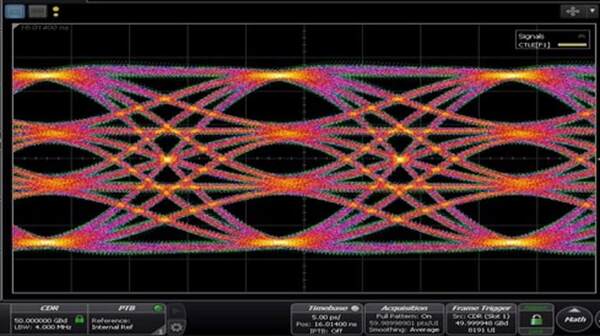
Figure: Oscilloscope capture of a 112G PAM4 eye diagram on Cadence IP, 50 GBd, showing the three eye openings characteristic of four-level signaling and the tighter voltage margins that define PAM4 link analysis.
Using Eye Diagrams Throughout the Design Flow
One of the most common mistakes is treating the eye diagram as a final validation step.
In pre-layout SI simulation, the eye helps determine whether the channel can support the required data stream at the target data rate. If excessive signal loss or fundamental impedance mismatches exist, they appear early.
Post-layout channel analysis incorporates the actual routed geometry of the PCB design, showing how trace lengths, coupling, and discontinuities affect the signal.
Measurement validates how the system behaves in real time, capturing the combined effects of design, materials, and manufacturing variation.
How Cadence Tools Support Eye Analysis
Tools like Sigrity X, integrated with Allegro X PCB Layout, allow engineers to generate and analyze eye diagrams throughout the design process.
This integration connects PCB design decisions directly to signal integrity outcomes. Engineers can evaluate how a digital signal behaves as it propagates through the channel, identify sources of signal loss, detect impedance mismatches, and refine the design before hardware is built.
Figure: Sigrity X eye diagram showing DQ and DQS waveforms for a DDR Data_Write simulation at the receiver die pad. Overlaid traces across all byte0 bits reveal how skew, noise, and signal variation distribute across the data bus within the timing window.
Practical Takeaway
An eye diagram is not just a compliance artifact. It is a compact representation of how a digital signal behaves as it travels through a real system.
Loss in eye height points to amplitude degradation driven by signal loss and material effects. Loss in eye width points to timing issues tied to jitter and clock signal stability. Structured distortion points to impedance mismatches, return loss, and discontinuities in the layout.
The value comes from connecting these observations back to the design. When used this way, the eye diagram becomes a practical tool for improving the data stream, strengthening the communication system, and delivering better system performance.